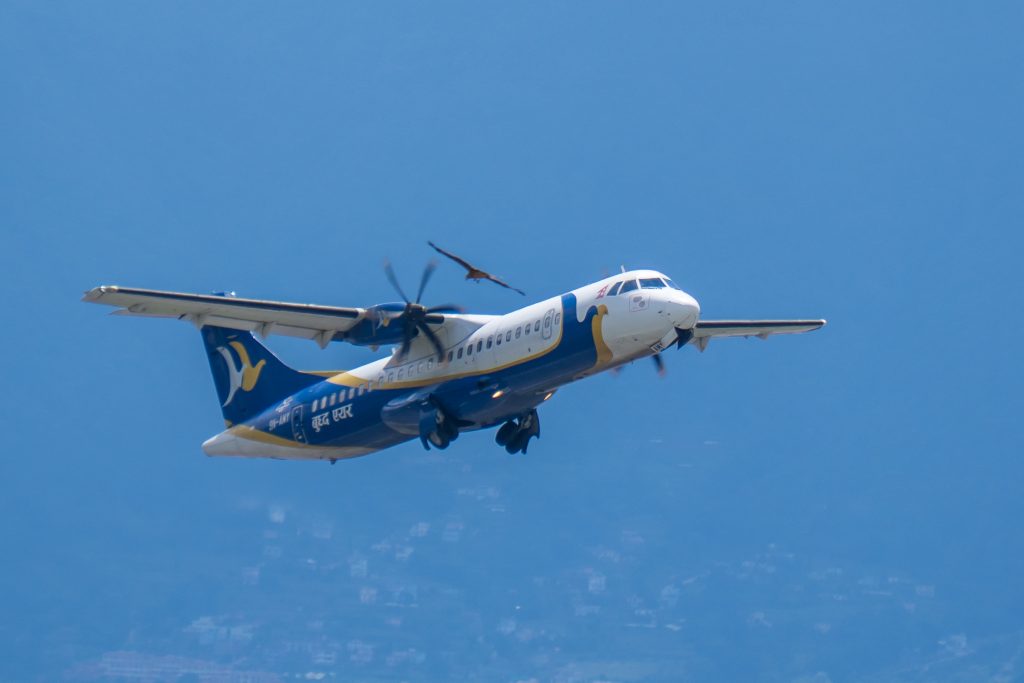
On 24 July 2026, Nepal’s aviation industry entered a new chapter with the arrival of 9N-AOS, Buddha Air’s first ATR 72-600.
The aircraft’s landing at Tribhuvan International Airport introduced the ATR 72-600 generation to Nepal for the first time. Until now, Buddha Air’s larger aircraft fleet had mainly consisted of the earlier ATR 72-500, a model that has played a major role in expanding reliable domestic air connectivity across the country.
Buddha Air had announced that 9N-AOS would fly to Kathmandu from Toulouse, France, via Egypt and Muscat. Aviation officials described its arrival as the beginning of a new technological era for Nepal’s domestic airline industry. After 6 hour 57 minute flight from Muscat it landed into Kathmandu.
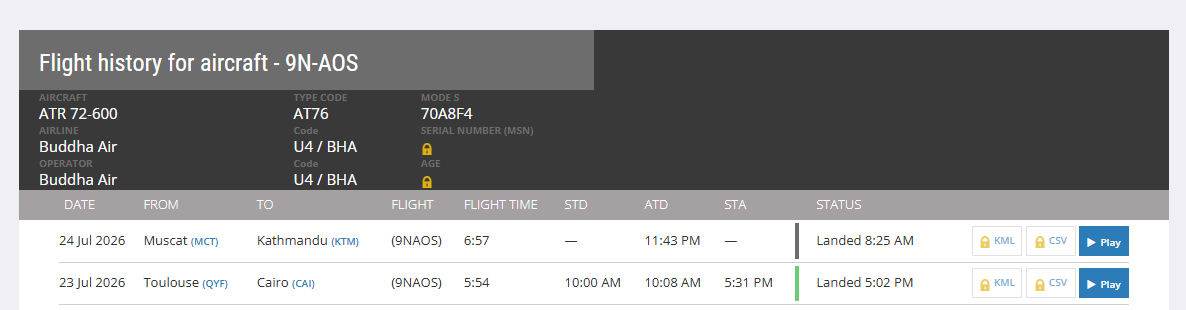
A New Generation : but Not a Factory-New Aircraft
The arrival of 9N-AOS has sometimes been described as Buddha Air receiving a “new aircraft.” More accurately, it is a new-generation 600 series aircraft model for Nepal, rather than a factory new airframe.
The aircraft was manufactured in 2012 and is approximately 14 years old. It previously operated in Brazil under the registration PR-TKL and was associated with TRIP Linhas Aéreas and later Azul’s aviation network.
9N-AOS Aircraft Profile :
Last Updated: 25/07/2026
| Aircraft detail | Information |
|---|---|
| Current registration | 9N-AOS |
| Operator | Buddha Air |
| Aircraft model | ATR 72-600 |
| Manufacturer serial number | MSN 992 |
| First flight | 21 February 2012 |
| Approximate age | 14.4 years |
| Manufacturer test registration | F-WWLR |
| Previous registration | PR-TKL |
| Previous country of operation | Brazil |
| Previous operator association | TRIP Linhas Aéreas/Azul |
| Production site | Toulouse, France |
Despite being pre-owned, the aircraft represents a significant technological advancement for Buddha Air and Nepal because the ATR 72-600 incorporates a newer cockpit, upgraded avionics, improved engine management and a more modern passenger cabin than the airline’s existing ATR 72-500 generation.
ATR 72-500 and ATR 72-600: What Is the Difference?
From the outside, the ATR 72-500 and ATR 72-600 look almost identical. Both belong to the same ATR 72 airframe family, have similar dimensions and can generally accommodate around 70 to 72 passengers.
The biggest differences are found inside the cockpit, aircraft systems and passenger cabin.
The Glass Cockpit Is the Biggest Upgrade
The most noticeable technical improvement in the ATR 72-600 is its glass cockpit.
Instead of relying mainly on the older arrangement of individual analogue and early-generation electronic instruments, the -600 presents essential flight, engine, navigation and system information through integrated digital displays.
The ATR 72-600 includes improvements intended to increase efficiency and reduce operating costs. However, claims that it uses around 45 per cent less fuel should be interpreted carefully.
ATR’s widely promoted fuel-saving figure compares its turboprop aircraft primarily with similar sized regional jets, not directly with the ATR 72-500.
Compared with the 500, the 600’s advantage is more incremental. It comes from upgraded engines and engine management, improved avionics, operational optimisation and newer onboard systems. The 500 was already designed as an economical turboprop aircraft.
ATR says the ATR 72-600 can consume up to 45 per cent less fuel and produce up to 45 per cent less carbon dioxide per trip than comparable regional jets.
This efficiency is particularly relevant in Nepal, where aviation fuel is expensive and most domestic sectors are relatively short for which turboprop aircraft are especially effective.
9N-AOT Expected to Follow
The arrival of 9N-AOS is expected to be followed by Buddha Air’s second ATR 72-600, reportedly assigned the Nepali registration 9N-AOT.
Buddha Air previously stated that a second ATR 72-600 would arrive within approximately one month of the first aircraft. The company also indicated that Nepali pilots would travel to France for training and would participate in bringing the second aircraft to Nepal.
Once 9N-AOT joins the fleet, Buddha Air will have two ATR 72-600 aircraft and will be able to begin establishing the model as a regular part of its operational system.
The arrival of multiple aircraft is more significant than the acquisition of a single example. It allows the airline to develop pilot rosters, engineering procedures, spare-parts planning and route scheduling specifically for the -600 generation.